




The 7 Steps Every Carbon Fiber Part Goes Through (and Where Each One Can Go Wrong)
Seven steps between a roll of fabric and a part on your car.
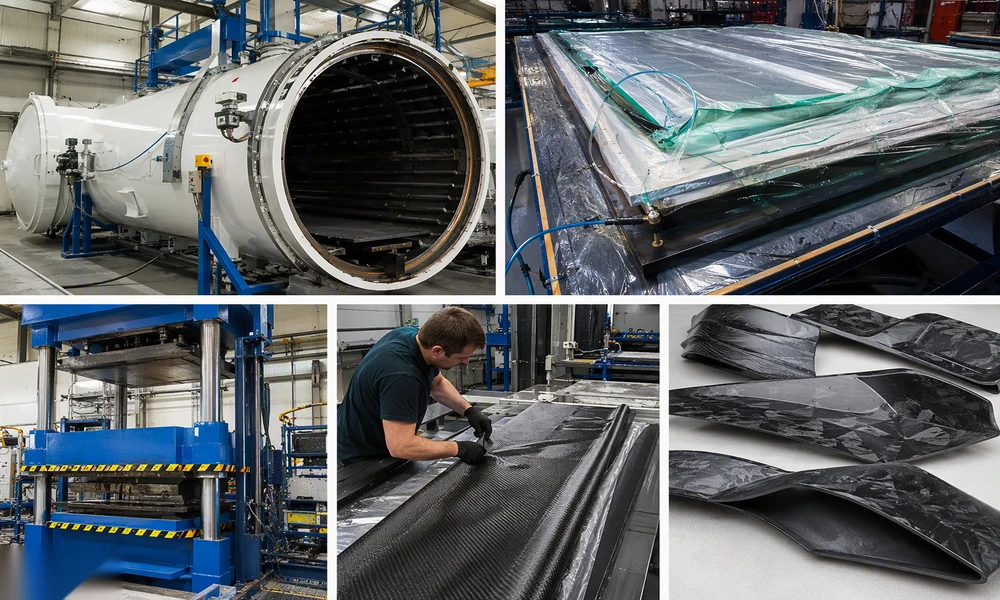
Strip away the marketing and every carbon fiber car part, from a mirror cap to a full widebody kit, travels through the same seven stations. Knowing them turns you from a spectator into an inspector. Here is the whole pipeline, with the failure point at each stop, because that is where the money and the quality actually live.
Step 1: the Mold
Everything starts with tooling. A mold is CNC-machined or hand-built to the part’s exact shape, then polished to a mirror finish, because every flaw in the mold prints onto every part it makes. A wave in the mold is a wave in a thousand hoods. Good molds cost serious money and serious time, which is why shape accuracy is the first thing that separates real factories from garage operations.
Molds also wear out. Gelcoat molds fatigue after a certain number of pulls, and the hundredth part from a tired mold is measurably worse than the tenth. Professional operations track mold life and retire tooling on schedule; budget operations pull parts until the mold dies in service. When one seller’s entire production run fits slightly wrong, an overworked mold is the usual suspect.
Step 2: Cutting the Fabric
Carbon fabric is cut into patterns, either by hand with templates or by CNC cutter. The cutting plan decides fiber orientation across the part. Where the weave runs lengthwise for strength, where it crosses for stiffness. Sloppy pattern cutting is invisible from outside the finished part and expensive inside it. This is the first place engineering quietly happens.
Step 3: Layup
The cut plies go into the mold one at a time, in a designed sequence, each one smoothed down to eliminate wrinkles and bridging over corners. Layup is skilled handwork. Fast is easy, good is slow. Wrinkles and bridging become voids, and voids become cracks. The carbon fiber manufacturing process shows how professional shops sequence this stage, and it explains a lot about why good parts cost what they cost.
Step 4: Resin and Consolidation
Now the fabric becomes a laminate: resin is introduced and the stack is consolidated under vacuum, pressure, or both, depending on the process. The goal is a precise fiber-to-resin ratio with zero trapped air. Too much resin means weight and brittleness; trapped air means hidden weak points. This step has the biggest single influence on the part’s final strength, and it is where the dry carbon vs wet carbon difference is actually born.
Step 5: Curing
The resin hardens through a chemical reaction, accelerated and completed by heat. Room temperature for budget epoxies, controlled oven or autoclave cycles for serious parts. Cure is chemistry with a schedule: pull a part early and the resin never reaches full strength, leaving it soft, warp-prone, and vulnerable to heat for the rest of its life. You cannot see an under-cured part. You discover one on the first hot day.
Step 6: Trimming and Finishing
Out of the mold, the part meets the trimmers: edges cut to final lines, mounting holes drilled, surfaces sanded. Carbon dust is hazardous and edges are razor-sharp, so this stage is equal parts craftsmanship and safety protocol. Clean edges, straight holes, and reinforced mounting points are the visible signature of a shop that cares. And the back of the part, where no customer looks, is the honest place to check.
Step 7: Clear Coat and Inspection
The last station applies the clear coat, the UV armor that decides whether the part looks new in two years or ten, and inspects the finished piece under bright, angled light. Good shops reject parts here that most customers would happily accept. That rejection pile, invisible to you, is what you are actually paying for.
Serious operations add one more layer you never see: documentation. Batch records, cure logs, resin lot numbers, inspection sign-offs. The paper trail that lets a factory trace a flawed part back to the exact shift and material lot that made it. This is how aerospace discipline looks at automotive scale. When a supplier mentions traceability, that is what they mean, and it is worth more than any marketing adjective.
Between every two steps sits something the list leaves out: waiting. Fabric waits for molds, layups wait for ovens, parts wait for clear coat to cure. A quality part spends most of its calendar life waiting, and every attempt to compress that calendar is a quality decision made against you. Fast and good exist in this industry, but they do not share a price point.
Reading a Part Backwards
Now you can read any carbon part backwards through its own biography. Yellowing says step seven was thin. Heaviness says step four was sloppy. Cracks at mounting holes say step six was rushed. Wavy reflections say step one was cheap. Seven steps, seven signatures. And the part in front of you is happy to testify, if you know how to ask.